
As soon as I thought about the title of this blog my mind went straight to the gutter. It would have been too easy to make jokes about male appendages, the Janka Hardness Index, or the preferred stiff characteristics of hardwood over soft wood but clearly I’m more mature than that. Wait a minute. WTF is a Janka Hardness Index? That’s what Google is for, and there’s your homework assignment. (You’re welcome).
I’m not sure how many readers I might have just lost with that intro but if you can’t inject a little of your own personality and humor into something like a woodworking blog, you’ve got no business writing a woodworking blog.
Let’s get right to it. Pine is my favorite wood of all time! <wince> Kidding, but only partially.
I do have preferences for certain softwoods and certain hardwoods given the desired outcome for each specific project, but every species of wood has a place in my heart for its unique utility and its beauty. That statement will be the basis for this blog entry as I’ll list my favorite varieties of wood based on years of hands on experience and the woods I’ve personally worked with. I’ll also share where I think that species is best used and in some cases where it shouldn’t be used. If you have a different experience with a particular variety I’ve listed below, please drop off a comment or start a discussion!
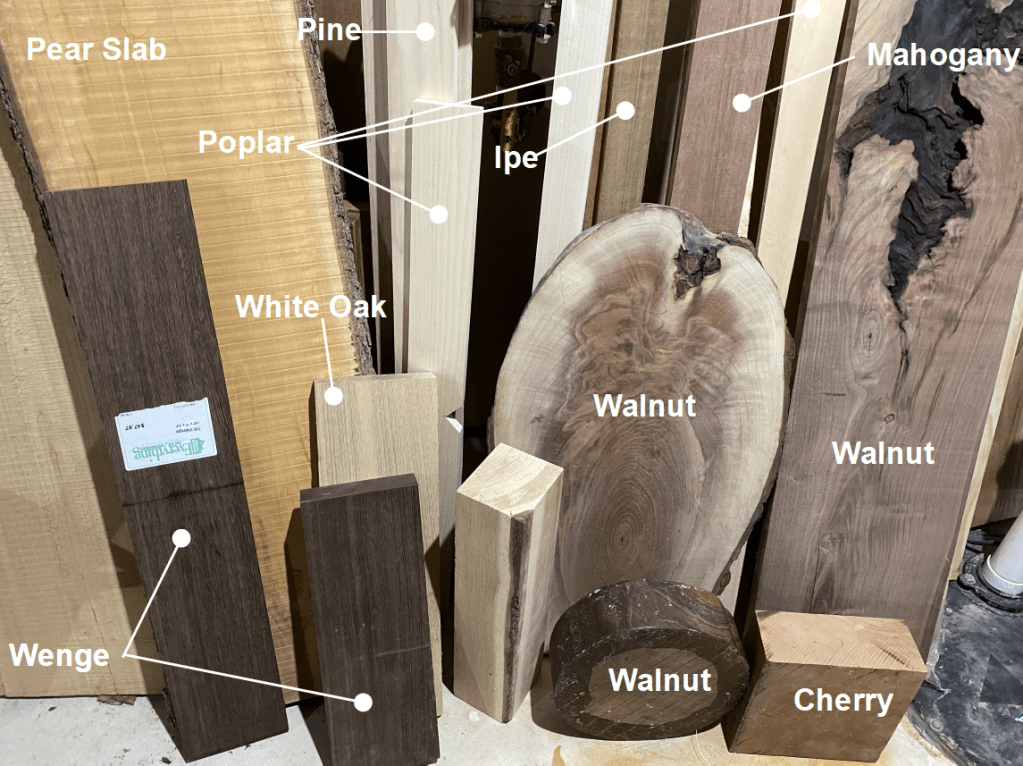
Pine: Okay, I like varieties of of this soft wood conifer but for limited uses. It’s obviously what you choose for rough construction and framing, and it is the cheapest and best option to build things like garage work benches and shelves, door trim or sub frames for custom cabinets. It even looks pretty good as a rustic fireplace mantel when stained but it is not a great option for any sort of furniture, indoor or outdoor. It must be kept free from moisture to avoid rot. Best when burning brightly in your fire pit.
COST: Low | GRAIN: Knotty | DENSITY: Soft | RIGIDITY: Bendy | CUTTING: Easy
Cedar: Better for outdoor house trim and basic exterior furniture like Adirondack chairs and benches. Natural oils in the wood make it resist rot and insects and it is somehow lighter than Pine but more rigid as well. Finding clear / knot-free Cedar is difficult and more expensive than Pine, but it makes for great Outdoor Irish Chairs, also known as Paddy-O-Furniture. (really bad humor)
COST: Modest | GRAIN: Knotty | DENSITY: Soft | RIGIDITY: Firm | CUTTING: Easy
Poplar: An even grain softwood that serves well for painted cabinets and doors and interior wall and door trim. It commonly carries a green tint to the wood grain so painting or staining is my preferred approach for finishing. Still not a great choice for fine furniture as it is too soft and dents easily. Great for making drawer boxes and small storage boxes too. Prone to moisture rot as well.
COST: Modest | GRAIN: Even | DENSITY: Soft | RIGIDITY: Firm | CUTTING: Easy
Aspen: Not commonly available at retail locations but I really like this wood. The grain color is very light / almost white so it makes for a cool accent color against other wood varieties when paired up on projects. It is light in weight and soft so again not a great furniture option unless we’re talking about trim. I used Aspen on a canoe paddle build last year with a little Mahogany, sealed it with epoxy and it kicks butt on the water.
COST: Modest | GRAIN: Even | DENSITY: Soft | RIGIDITY: Firm | CUTTING: Easy
Birch: My son and I disagree on Birch a bit. He likes the light color of the wood and it’s availability as a veneer on plywood projects. I’m less of a fan because of its constant desire to turn into a fuzzy lollipop when sanding it. I can never seem to get the “little hairs of woodgrain” sanded down for a final finish.
COST: Modest | GRAIN: Even | DENSITY: Soft | RIGIDITY: Bendy | CUTTING: Easy
Red Oak: The first and most common of the hardwoods on the list. Common is a good word for it though. It’s widely available and an upgrade on interior trim. It is dense and rigid enough for making indoor furniture but Red Oak is pretty grainy and you’ll never completely sand the surface smooth. If you like rustic, then this is a good choice. Not a great candidate for exterior or wet applications as the end grain sucks up moisture like a sponge. See my video on “canoe finishing hacks” to see this capillary action.
COST: Modest | GRAIN: Even | DENSITY: Harder | RIGIDITY: Firm | CUTTING: Moderate
White Oak: Love this stuff but it is hard to source and it is expensive. Tight grain compared to Red Oak and much more dense. Commonly used on mid century Mission style furniture and I’ve made my best Mission and Craftsman period furniture pieces from White Oak and you can find those videos on my channel. Quartersawn White Oak is off the hook pretty. Cutting White Oak fills the air with aromas of vanilla and butter like a fine white wine. Critics are now telling me to “put a cork in it”.
COST: Pricey | GRAIN: Even | DENSITY: Hard | RIGIDITY: Firm | CUTTING: Hard
Cherry: Another favorite wood choice for fine furniture and often used (like White Oak) in mid century Mission style furniture designs. It is mostly knot free and the wood grain is tight with a reddish tint to the wood. It is a dense and rigid wood variety again making it a great choice for any heirloom piece you’d like to design. I chose Cherry to finish the rub rails of my Cedar Canoe and it holds up well to moisture. Staining the natural beauty of Cherry is a crime punishable by shaving your head bald. If you’re already bald, then shaving the letters “DUH” into your back hair.
COST: Pricey | GRAIN: Even | DENSITY: Hard | RIGIDITY: Firm | CUTTING: Moderate
Walnut: The Mac Daddy. The rare Black Truffle. The Chairman of the Board. Brienne of Tarth defending House Stark. It’s smooth and dense and dark and complex. The grain can be as straight and linear as you prefer or it can be found with swirls and twists and shimmers that change with the angle taken to view it. It makes for wonderful furniture and even cooler trim pieces against lighter colored woods. You’ll need to take out a small business loan to buy this stuff so be sure to measure 25 times and cut once.
COST: Ugh | GRAIN: Even | DENSITY: Hard | RIGIDITY: Firm | CUTTING: Moderate
The “Maples”: How confusing can buying a wood variety be? You see “Maple” at the big box home center and think you’re getting that same super hard stuff found on bowling alleys and wood floors, but nope. The generally available retail stuff is Soft Maple, but that’s a name not a density classification. It’s wonderful for furniture and heirloom boxes and the even grain and color make it great for staining. Hard Maple is “harder” and heavy and though more expensive, makes for better high usage furniture and things that might take some abuse like butcherblock tables and countertops. More colorful and rare Maples include Ambrosia Maple and Spalted Maple both suffering from insect or fungus infestation but producing some awesome color as the tree dies off. I’ve used plenty of Hard Maple in cutting boards and just finished a cool men’s valet box with a secret hidden tray using Spalted and Ambrosia Maple. Be sure to check out that video! Maple; It’s not just for pancakes anymore.
COST: Pricey | GRAIN: Even | DENSITY: Hard | RIGIDITY: Firm | CUTTING: Hard
Ipe: This Brazilian Walnut variety is pronounced “Eee-Pay” and is near the top of the Janka Hardness index. It is a dense and oily hardwood which is wonderful for outdoor projects but it is ridiculously expensive. I love using it for small projects like a golf putter or a Viking sword I made a couple years ago and most recently, a kinetic garden sculpture when I knew it would get wet. It is also a sliver factory with stringy wood grain and will draw blood until you get it sanded. People with unlimited budgets use it for exterior decking and it looks wonderful without maintenance. Smells funky when cutting it, and you can watch your saw blade get dull in real time. The oil in the wood also needs to be removed before glue up. Hey, if you’re not ruining saw blades and drawing blood, you’re not having a good time in the wood shop.
COST: OMG | GRAIN: Even | DENSITY: Super Hard | RIGIDITY: Granite | CUTTING: OMG
Wenge: This is the closest to a natural black woodgrain you can find without it being Ebony. Pronounced “Weng-Ay”, this expensive exotic hardwood is desirable because of its color as an accent to a lighter wood, or as a stand alone frame or art piece on a lighter wood desk or painted room. Because of the cost, I’ve used it for smaller pieces like another wood putter (my favorite), and for picture frames if the art piece is lighter in color. Check out my recent video on a multi colored wood art piece framed in Wenge. It is hard to cut and has long stringy thin wood grain making it another sliver factory, but it is stupid beautiful when finished. Love it. Bleed a little and love it too.
COST: OMG | GRAIN: Even | DENSITY: Super Hard | RIGIDITY: Firm | CUTTING: Hard
Padauk: This African hardwood pronounced “Pa-Dook” comes with a rare orange-red wood grain color and that alone makes it stand out from other wood varieties. If you don’t like the color red in your finished piece, then skip this one. Because of the cost, again, I’ve used this for smaller projects and as a trim wood when matched or stacked against other wood varieties. Cutting and sanding this wood leaves your hands looking like you’re a murderer, but thankfully the red staining washes off pretty easily. My favorite project was creating a round snare drum shell out of this wood and the wood alone cost around $150 (2022 money). I lent it out to a drummer/former co-worker for testing and reportedly the sound was amazing. I never heard from that guy or saw the drum again. I guess that helps validate my chops as a woodworker whose products are desirable. I guess. “No dude, you cannot borrow my Wenge putter”.
COST: OMG | GRAIN: Even | DENSITY: Super Hard | RIGIDITY: Firm | CUTTING: Hard
Bubinga: Say that word like you’re watching The Big Bang Theory and listening to Sheldon yell out “BAZINGA”. This is another really hard and heavy wood variety from Africa with a more subtle reddish-light brown grain that makes it stand out against other species. I like mixing that color with something like Wenge to pair that reddish grain against the black of Wenge. My favorite Bubinga project was creating a thick art frame for a Jackson Pollock tribute painting a couple years ago. The Bubinga center core was sandwiched by two thin layers of Wenge which made for a really pretty frame. Look for that Jackson Pollock painting video on my Youtube Channel.
COST: OMG | GRAIN: Even | DENSITY: Super Hard | RIGIDITY: Firm | CUTTING: OMG
Wrapping Up: I’ve played around with other wood varieties as well but not enough to say I’m super-experienced with the characteristics of the wood. I choose a particular variety for a project based mostly on the texture of the grain and the color of the wood. For a recent video on creating new chef knife handles, I liked the woodgrain in Cocobolo wood. It was funky and really pretty when finished and the wood variety worked well in wet conditions where food safety was a consideration. I used Holly for a salt shaker because the wood is bright white. We’ve also used other varieties like Mahogany, Lacewood and Bloodwood in smaller projects where we’re cutting small pieces to be used up against other colors and textures. In the end we buy what we think will look best and perform best under the project scenario laid before us. My son Matt and I are always on the look out for the next beautiful thing, and we’ll add a new species to our list if the need arises. But the list above represents our years of experience and regular use of each wood variety.
We love them all.
Except Wenge and Ipe that is. They look cool but I can never keep enough band-aids in stock.
 TFW Woodworking