
Yes, let’s pull out the whips and chains to show that lumber who’s boss.
“You think you’re all rough and tough on the outside, eh? I can already see that you’ve needed a shave for days; Such disrespect. You try to hide it but a keen eye can see that you truly are a twisted one. You can’t even stand up straight with that poor posture. Your bent spine leaves you almost useless for furniture work. Just because you saved me a few dollars doesn’t mean should let yourself go. A few hours in the kiln and your whole exterior decides to throw in the towel and give up. You can’t even be touched without your prickly exterior leaving me a sliver in the palm of my hands. I guess that’s your way of giving me something painful to remember you by. Sadist. You’re useless, pitiful and hopeless. Now, shut up and get up on the table saw. I don’t have all day.”
If this was a 50 Shades of Grey novel, that might be Chapter 1 of our experience with milling up about 50 board feet of rough sawn and kiln dried Red Oak lumber we found from a local supplier. None of our experience with this new sawyer was bad at all. In fact we met this super nice guy who just happens to sell different varieties of hardwood out of the back of his heated barn. He just prefers to remain anonymous so to keep the satirical analogy going we’ll just call him Christian Grey.
I had written before that I like to shop local and that we had found a guy in our zip code with decent wood stock available. Quite the operation to behold really. This man had constructed three separate and large climate controlled buildings to support what could only be called his “hobby”. The first was his wood shop. Long and wide, this 3000 square foot building was beautifully laid out with every dream woodworking tool imaginable and all were industrial in size and capacity. I drooled over his 36 inch wide drum sander, and his 8 inch helical jointer with an 80 inch table.
I know, I know. With my wife and my daughters it’s a shoe sale and a visit to the Coach outlet store that gets them excited. Not trying to be an insensitive, sexist pig here, that’s just the way it is in my house. Though there’s hope with my youngest daughter who has been using power tools to fix and update certain things in her new condo. (Daddy is so proud) But for me, it’s looking at woodworking tools that I could never fit into my shop or afford to write the check for. I’m off topic again. Again.
The second building on Mr. Grey’s property housed his sawmill and kiln and he tells us that he can regularly reduce the cut lumber moisture content down between 6% and 8%. We checked. He can. Wait a minute. This guy has his own sawmill and kiln? Shoot me now.
Finally, the third building is where his rough cut lumber is stacked. At the time of our visit he had White and Red Oak, Maple, Walnut, Cedar, Pine, Aspen, Birch and some quartersawn options as well. Now, I’m generally not a fan of Red Oak when White Oak is available but I knew we would be staining the next project so the species mattered less. Red Oak is less expensive per board foot and that’s what we opted for.
Mr. Grey mills all his lumber to about 5/4 in dimension before kiln drying and our chosen Oak boards came in after the kiln at about 1 and 1/8 of an inch in thickness. We hoped and the key word there is “hoped” we could save as much of the board thickness as possible for our project.
It was laborious picking out the boards because none of them were milled beyond the initial bark-removal cuts. That meant that all the boards were as wide as possible leading up the sap layer (the outer layer of the tree before the bark). I had calculated the amount of lumber I would need based on common pre-finished widths you could find with a lumber yard 1X6 and 1X3. My calculations went out the window with board widths at 13 inches, 9 inches and 5 inches. We also found a few bananas and twisty straws on the top of the pile so it was evident that the lumber pile had already been picked through. We did settle on some winners further down.
I forgot to bring gloves so the fresh lumber left me with a couple of prickly and bloody souvenirs. “No Mark, this was not a regular trip to LoweNards Depot.”
“Man up. Glove up, Shut up”.
Once unloaded down in the shop and laid out on my work table, it became more clear that we would have quite a bit of finish mill work to do. Even when the boards look flat and untwisted, reality will smack you in the face with a black leather glove. We’re back to 50 Shades analogies. You love it. You know you do.
Matt and I had marked up the lumber to select the best facing options for table tops and for the headboard in our project. Since some of the lumber was a little twisted, we took as much of the twist out of play as possible, making initial cuts in the centers of each board and away from the worst of the twist. This step actually saves some of the thickness loss during surface planing. Think about it. Trying to level out a twisted board at 8 foot long where the opposing tips might be ½ inch off center between ends. You would take that ½ inch of thickness off the entire board to get it flat across the whole length. But if you cut around the worst of the twist or cut the board in half, the end to end difference is reduced meaning you need to remove less material to achieve “flatness”, if that’s a word. Yes, I just checked. We’ll go with flatness!
In the end, our surface planing only needed to remove less than a quarter inch of total thickness to get to a usable and smooth piece of lumber. All our boards measure in about 7/8 of an inch thick. Thicker support and a better look than the ¾ standard stuff you get from retail lumber yards. But, we weren’t done whipping this lumber into submission.
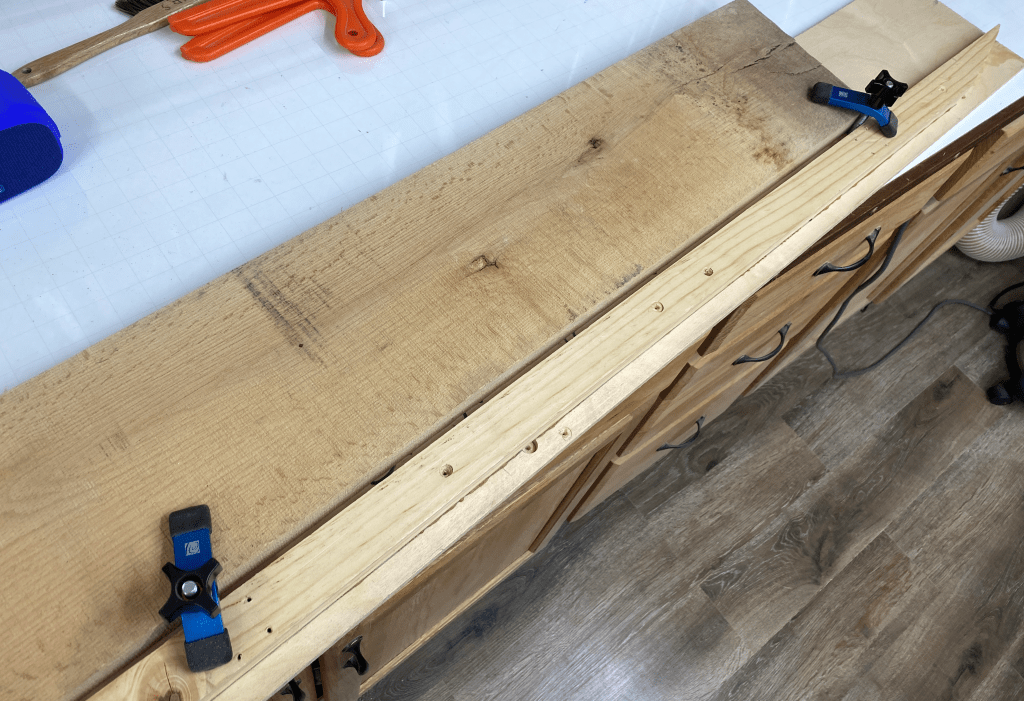
None of the edges were straight. Our next step then was to set up each board on a straight edge jig, clamped down on the jig so that each piece could be run through the table saw for a 90 degree rip cut. Our jig is a ½ inch thick piece of plywood, squared up on the fence where simple overhead clamps hold it on the jig for a single straight pass. Once you cut a clean straight edge on one side of the board, you simply need to run that flat side on the table saw fence for the rest of your rip cuts. Using a good 60 tooth trim blade on our table saw also meant that the edges were pretty smooth and could be used as is for the rough length cuts. There was no need to run the boards through a jointer which is good, because I don’t have one. I’ve had great luck on glue ups against those 60 tooth blade cuts without a joint failure. (See the straight edge jig picture below)
So was the milling effort worth it? I think there are 4 points to consider before answering. First, it’s about the ability to get thicker lumber than available from places like the ubiquitous LoweNards Depot. The second perspective is the amount of work required to get a finished piece of lumber. Third, is the overall cost savings enough of a motivator to support milling the lumber yourself? Finally what about the convenience factor, the easy perspective? If you look at just those factors, the result is a 2-2 tie. I like thicker lumber and there is definitely a cost savings doing it yourself. But considering the amount of work required and the convenience of buying a project ready board, that makes the decision a tie.
Hey. I forgot the “X” factor. We just took bananas and twisty straws and splinter factories and beat them down into three pieces of beautiful furniture. We did that. Pride and personal accomplishment is the X factor. The X factor tips the scales. We will do this again. I’ll bring my gloves next time but leave the whips and chains back home. 50 Shades references are now done, never to be spoken of again.
Best,
Mark & Matt

 TFW Woodworking