
I almost titled this blog as “My Favorite Tool” but quickly realized that I might be attracting the wrong sort of reader to my site. I say that knowing that I’ve included some questionable double entendres in previous blogs, but there you go. You can’t put me in a blog category box. I’m a puzzle.
It’s true that most woodworkers tend to accumulate tools over time especially when we have a specific need for a solution and no tool to solve the problem. Yes, there are some examples where I’ve used that excuse to rush out and buy a tool that I didn’t have. Need to remove some bad tooling marks on a Walnut slab and don’t want to spend hours sanding it smooth? Hey! I need an electric hand plane! You always need another tool. It’s the clamp joke all over again. “I have too many clamps… said no woodworker, ever.”
I spent a lot of time thinking about the projects I’ve done over the last 20+ years and the tools I’ve used most often during that time span. I think my list will be skewed a bit based on the projects I’ve done versus the projects you might have tackled, but then again it’s my list. There will be obvious omissions here too like a jointer. I just don’t have one. I don’t have room on my bench for a table top jointer and if I ever got one, I’d want a wider planing surface and a longer table for bigger lumber. But, that specific gap forms a natural segue to my number one most used tool in the shop. Wait a minute, I think I just created a top 10 list.
Numero Uno – Table Saw
More than any other power tool in the shop, this one gets the most usage by far. A well calibrated table saw that makes true 90 or 45 degree cuts (or any degree in between) can get you pretty far in your workshop without any other tool. I just finished building a headboard and two bedside tables for our guest bedroom and all the joint edging and bevel cuts for my Mission style legs and posts were cut on the table saw.
I mentioned jointing the edges of boards here because I did have to glue up multiple Oak planks for the table tops. Without a jointer, I’ve either used hand planes to try and get me to a 90 degree clean edge for gluing or the better option, using a 60 tooth trim blade on the table saw. Making sure my saw blade was exactly set at 90 degrees to the table, or what says zero degrees on your saw gets me a super clean edge for glue up. Using my table saw and a trim blade for jointing has never led to a glue joint failure.
Personal tip: Buy more than you want to spend when you select your table saw. About 4 years ago I bought a Delta “Contractor” table saw from Lowe’s and at the time it was $599. For me that was a lot of money but I used it a ton. In the end the internal steel parts wore out where they shouldn’t have and parts were unavailable from the manufacturer. I should have done more homework, read more user reviews and spent more to get better quality. If you’re really only using your table saw once every couple months for small household projects, then you might not need to spend a lot. For me, I’m using this tool multiple times each week and the beefiness mattered. “Beefiness.” I’m still surprised this is actually a word. Sort of like every fast food restaurant using the word “Melty” to describe their cheese. Melty is not a word.
Number Two – Cordless Drill
It seems like I should naturally progress to another large footprint tool on this list, but the focus is on usage rather than size. (I’ll skip the overused ‘Size doesn’t matter’ joke here…) My cordless drill seems to be the next tool being reached for after something comes off the table saw. That might be because a lot of my furniture designs are influenced by the Mission and Craftsman period and those furniture pieces always feature dowels as part of their joinery and decoration. Dowels mean drilling and well, there you go.
I think I could have said just the word “drill” here as I use my corded drill for a lot of exterior projects that require endless high torque drilling and where batteries just don’t last. For inside my shop however, the cordless drill is always sitting on top of my work bench with some sort of bit stuck in it. If I’m not drilling holes in something, I’m driving screws into something. Definitely the second most used tool in my shop.
Number Three – Clamps, Clamps, Oh Yes, More Clamps
This isn’t just a discussion about power tools so I need to make clamps the number three most used tool on my list. The clamp joke is well rooted in reality by the way. When we were working on our 16 foot Cedar canoe and needed to epoxy the inwales and outwales to the hull, our spring loaded hand clamps didn’t provide enough clamp force. Guess what we had to do.
Now that I have about 30 “F” clamps in stock, they get used all the time. Maybe not all 30 at the same time but I’ll be ready for another boat build should that day come. The same is true for wider table top glue ups. I only had three decent 24 inch bar clamps in my shop until I needed to edge glue a long and wide table top. Off to the store we went. Repair and re-glue the tenon joints on an antique 30 inch door? Off to the store we went. Now I have a semi-impressive clamp wall in the back corner of my shop thanks to my son, Matt where our growing clamp collection sits at the ready. Most of my recent videos will catch a glimpse of the clamp wall, or you’ll probably see clamps sitting all around the shop, holding wood stock down to the table or holding boards together. Clamps. An honest number three pick.
Number Four – Belt Sander(s)
I noodled over this pick as to whether or not this selection was number four or five, but let’s dive in at number four. I’m also cheating a bit on my list by combining two tools here in the same slot but I’m an unstructured and unpredictable little man with a penchant for controversy.
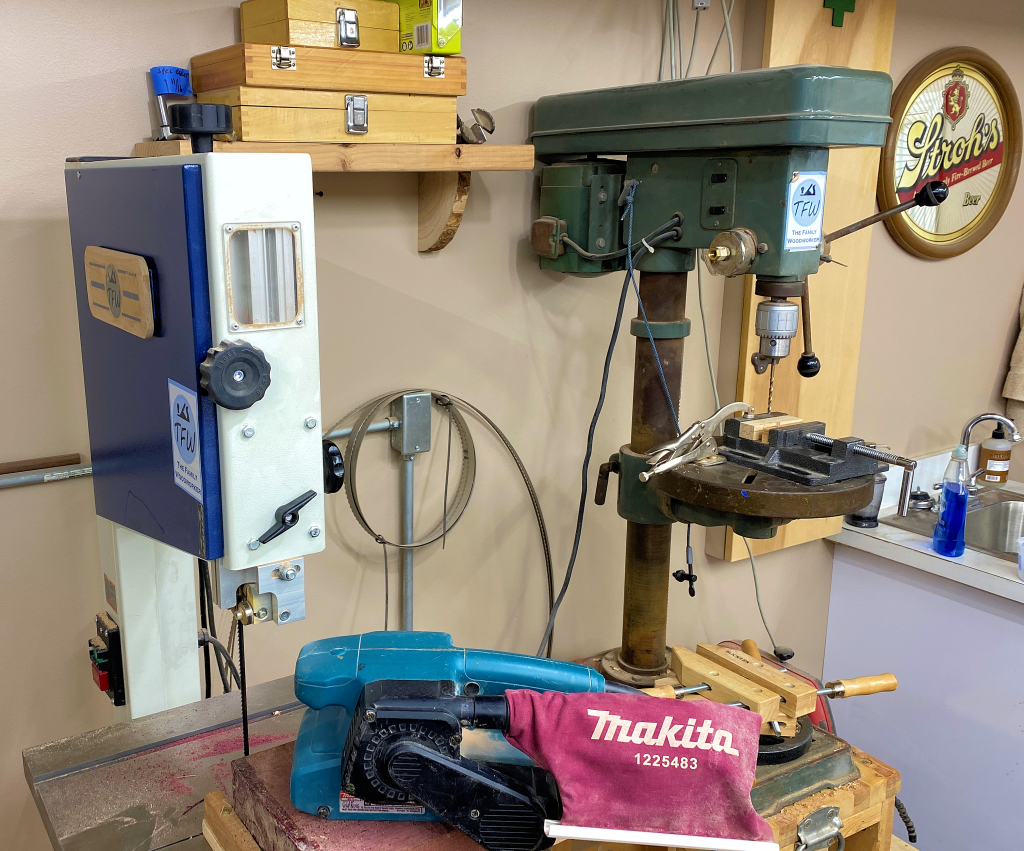
After making initial cuts on the table saw and unclamping whatever I might have glued up, many of the projects I take on require some initial rough shaping and sanding. Not so much on fine furniture, but when I’m doing an art project or a kinetic sculpture that requires me to put curves into wooden pieces, I’m either at the stationary wide belt sander and grinding wheel or using my hand held belt sander on something clamped up in my vise. When making a paddle to accompany the Cedar canoe we built during COVID, the hand held sander with a 40 grit belt did a great job removing material and thinning down the blade of the paddle. It was faster than using a hand plane and the right tool for the job. Shaping on smaller pieces is easier when holding them against the stationary belt sander, though you have to be careful. I’ve lost skin in an instant by getting too close to the belt. Band-Aids are definitely required, for me at least.
Number Five – Drill Press
At this point in the list I’d say that the usage of this particular tool is now about 50% of the time when compared to my table saw. I’m not always heading to the drill press for each project on my schedule but it gets semi-regular usage whenever, you know, I need to drill holes into something. Not aligned in usage to the cordless drill mind you, but whenever I need to drill straight holes down at 90 degrees into a block of wood. It is also the best tool when I need to use a forstner bit, since the torque against the wood is significant and it helps to be able to lock down or clamp down the wood stock on the drill press table.
The drill press is also useful for some specialty projects when I need to drill straight into a long wooden shaft or the end of a bigger dowel. I have created jigs and methods to help hold wood stock straight up so the drill bit can bite down into the middle of the shaft evenly. Hard to make that same hole with a hand held drill. I also use the drill press for some wire brush and polishing wheels, so the flexibility of the tool and the power of the motor can be used for many other activities beyond just drilling holes.
Number Six – Band Saw
When I can get through wood stock safely on my table saw, that is the preferred tool for straight line cutting especially with a wide out-feed table ready to accept the cut pieces. But when the wood stock is too thick or when I need to resaw a thin piece off a chunk of lumber, the band saw is the only tool for the job. Band saws come in different sizes and cutting dimensions and I think after the initial purchase it’s one of those tools where we all wish we bought something just a little bigger. Mine will handle material that’s up to 13 inches wide and almost 9 inches thick and sometimes that is still not enough.
There’s more flexibility with the tool too, given the variety of cutting blades you can use. Small width blades are great for cutting tight curves and wider blades allow for more tension on the vertical blade travel and are perfect for cutting through thick material.
Number Seven – Japanese Pull Saws
Time to insert a well used series of hand tools into this mix. I’m not opposed to the more traditional western style of push cut wood saws, but the Japanese pull cut design allows for a thinner blade and a faster cut in my opinion. If you picture the usage of a western push cut saw, the steel needs to be thicker so that it doesn’t flex as you push it against the stock. The Japanese design allows for the cutting motion as you pull the saw blade towards you. The steel can be thinner because of that pulling motion and a thinner sharp blade will take less energy and less material to get through your stock.
I much prefer this design for cross cuts, and really like my “Razor Saw” for cutting notches and tenons. My little Japanese flush cutting saw is also “Da Bomb” for trimming off wood dowels used in making Mission Style furniture. Does anybody actually say “Da Bomb” anymore, or is it just “Sick” now?
Number Eight – Thickness Planer
Falling a bit down on the list is our thickness planer. It is a necessary tool for thickness matching of boards before glue up, or when we’re working with rough sawn stock that needs to be milled, but it is not used on every project in our shop. It’s noisy and creates a ton of waste material in our dust collector and it’s kind of a pain in the butt to use.
My lack of enthusiasm about this tool is partly because I bought one of the smallest and cheapest bench top planers you could get. This was mostly because it was purchased at a time when I didn’t have a lot of extra money to spend on tools. We have had it for years and it works well enough and we do need it from time to time.
Number Nine – Wood Lathe
I love using this tool whenever the right project opportunity pops up. Nothing transforms a blah block of wood like a wood lathe. The problem is that cool projects requiring a wood lathe don’t pop up all that often and this particular lathe is designed to support small hobby work. If I’m creating small decorative wood bowls or other art pieces, this tool is awesome. You’ll have to check out my video on creating the Planet Mars in spherical form out of this red wood grain tree called Padauk.
My lathe isn’t big or powerful enough to turn big tree trunks or long fence balusters but is great for arts & craft work. It falls down on the most used list because, well, it is sadly not heavily used.
Number Ten – Scroll Saw
This is one of those tools that gets used and only gets used when you need to make intricate cuts with tight turns on a piece of wood. Most every other type of curved cut can be made on the band saw, that is until the turning radius gets too small. My son Matt uses the scroll saw for a number of his 3D art projects where the cuts are intricate and the curves are tight.
It’s also a tool that requires a lot of focus and attention as you cut since your fingers are quite naturally close to the blade. No slipping here or pay a hefty price. It’s also the tool with the greatest risk of snapping or breaking saw blades. Scroll saw blades are super thin, so they do not last as long as other types of saw blades. That probably explains why they are typically sold in packs of 10.
Number Eleven+ – Every Other Tool In The Shop
I think at this point we could equally rank just about every other hand tool or power tool in the shop. I’m just as likely to use my router as many times in a given month as my hand plane or a framing hammer or a screw driver or a chisel. But there’s always a tool I need that isn’t already in the shop. Sounds like another opportunity for a highly satisfactory wood store shopping experience.
 TFW Woodworking