
Returning from a short vacation spent in Vermont and Maine, I took last week and the Memorial holiday weekend to catch up on some shop work and some reading. I also spotted a few videos and news stories I wanted to consume, mostly as a way to stay connected with my former career in the computer technology and software industry. I was shocked but not surprised at how far artificial intelligence technology has advanced. Specifically, it is now replacing the fine work of actual people across multiple industries, effectively replacing artists and artisans. Where does it end?
When the CBS 60 Minutes news magazine has to add a disclaimer at the end of their program that says, “The preceding was created with 100% human content”, it’s time to worry. Political figures are seen on video doing and saying things that are found to be manipulated. Entire movies are shot with believable characters that are digital fabrications. Now with Google’s Bard or Chat GPT or other speech generators, you can provide some basic thematic phrases and a simply story line and the software can write an entire novel for you. Why bother to you know, do any work at all.
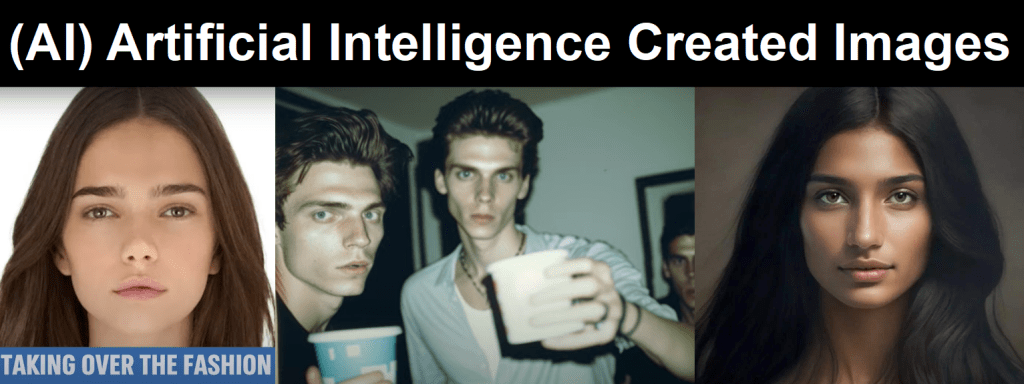
One of the video news articles I watched featured the current world of fashion modeling, and I’ve included some pictures at the end of this article to show you a new concept of scary. AI is able to create a perfectly symmetrical human face and body in either gender, any skin color, any hair style and with the features of any culture. It’s scary to look at some of the images and some to the realization that these people aren’t real. Worse, the fashion industry’s images of skinny, blemish free perfection adds to the weight society puts on young women and men to look as perfect as the images seen in that fashion magazine. It’s up to us I think to remind ourselves and our kids that those people probably aren’t people at all. The perfection is computer generated.
I was also enamored by a recently published series of older movie scenes manipulated by AI as if produced by Wes Anderson. They were amazing, and completely fake representations of the original actors. It was beautiful visual art and sadly not crafted by a human artist or artisan.
Over the last 20 years I’ve written three books under a pseudonym you won’t know. None of them were super successful and while one of them made enough money to go out to a nice dinner a few times a year, it wasn’t “buy a new car” profit. I did those projects because I wanted to do the work, create the story, languish over the hard edit work and then enjoy that feeling of accomplishment. I mention this because I was in the process of writing a fourth novel with what I thought was an interesting story line but never finished it. I got about 50,000 words into it and that is where it sits. When Google’s Bard was announced, I caved into a weak moment and tried to subscribe to the product. Since I wasn’t an educator or an approved beta user, I was placed on the waiting list.
There in lies the draw. Wouldn’t it be great to input a few of my chapters with characters already developed and have the software finish the story line for me? Wouldn’t it be easy to finish the novel that way and make it available to publishers for review? Wouldn’t it be wonderful? Except that I didn’t actually write it.
College professors have already weighed in on the dangers of more advanced AI text generators poisoning the world of higher education. It’s not plagiarism if you didn’t steal the words from another human author. You just used spell check on steroids, right? Different of course if you didn’t do any work at all aside from inputting some key phrases and context into the AI generator and telling the software to write your 3,000 word term paper for you. It will do all the historical research and summary and route it to your printer in the blink of an eye, leaving you more time for beer pong and DayZ pvp.
So far in this blog we’ve eliminated the need for human fashion models, writers, actors, photographers, editors, producers, directors, most all things connected with the fashion and entertainment industry. We’ve eliminated the need for people to actually learn anything that requires an understanding of history, context or advanced concepts. Have we just eliminated the need for colleges and universities? What about the business world, engineering, design, marketing, sales, distribution and customer service? Um, yeah.
Online chat sessions with your favorite retailer or financial institution are also well represented by AI chat technology. The older versions of that software invoke access to a data repository of common responses to problems and questions. When you try a chat and it asks you something back like “Did you mean you’re having trouble accessing your account?” It’s the older simpler knowledge based software. If the chat immediately responds to you at 10:00 PM with a well articulated and friendly response and adds a little small talk in there too, you’re in AI land.
AI is great at researching information and establishing patterns. It could eventually replace a bunch of human analysts across many businesses in order to help a company analyze industry data and devise, let’s say, a new company growth strategy. Who needs people for that? It could eventually handle all complex engineering activity in manufacturing. Sure you need to program in a basic set of parameters, limits and specifications, but the software can do the rest. Engineers? You probably won’t need a department full of them.
In a competitive marketplace, the first company to employ any new technology to gain a productivity and speed to market advantage is an early winner. My last employer was big on deploying something called Robotic Process Automation. In a nutshell, it replaced human to keyboard data entry when it came to processing incoming paper mail and electronic mail too. It made some next-step processing decisions based on what it captured, saving the company money for those people doing the data entry. Money was saved because those people were shown the door.
How does this all relate to my little world of woodworking? Maybe not all that much today or even next year. To some degree with the introduction of computer aided design and wood manufacturing, the concept of “hand made” is getting lost. Some argue that it’s still woodworking because a machine is actually “working the wood”, but it’s more computer programming than any part being hand made. However, I think if I had an unlimited budget for automation tools and AI software, it might be nice to shave about 20 years off my face and smooth out those wrinkles during video production. It would be efficient to have a machine cut all my project pieces to perfection. It would be easier to have the software write my video narratives for me. It might be cool to have my video show me working in a shop that looks like a Wes Anderson movie. It might be nice to have computer technology manipulate my voice to make me sound less like a dry husk of bread and more like Michael Buble. It would all be fake, but wouldn’t it be great?
The power of AI technology and automation technology in general scares me to death. The human impact from computer influenced efficiency (in any form) started decades ago with robotics replacing workers on production lines. It continues today as more technology gets introduced to the business world in the name of efficiency and profit. Efficiency gain is the buzz phrase for staff reduction.
Reliance on technology is also harming the education of our kids. High school kids at cash registers look at me funny what I hand them $12.50 for a $7.50 bill. I did the quick math to know I should get $5 back, but I get “You gave me too much” instead. “Punch it into amount tendered” I tell them. “Oh yeah”, is their response. Yes, most everyone expects us to pay with a debit card now. No math required.
My kids can’t drive anywhere without using a map app on their phone. Even when sitting in the passenger seat with me and I already know how to get to where I’m going, they bring up the app to validate the directions. “I know it says to take this dirt road because it’s shorter distance, but it’s not faster and my car will be covered in dirt”, I tell them. The previous week in Vermont, my Google map was supposed to be guiding us towards a small picturesque town, but put us next to a farmhouse in the middle of nowhere 90 minutes from the desired destination I found on a paper map. Thank you technology.
I’m not sure where this all ends. I spent more than 30 years as a technology advocate, but where that technology made sense. I was never a fan of the bright shiny new technology thing until we had good empirical evidence to show that it worked, and that it did no harm. I’m not sure AI is going to be good for society if left to explode within our society. It’s a similar argument to robotic automation in all it’s forms. If you let technology take over most all aspects of where people were previously required to think about stuff, research stuff, design stuff, manufacture stuff, pick, pack and ship stuff,what does the common person do for work and then money to buy that stuff?
So I guess my commitment to you as this curmudgeonly older woodworking guy, is that I’ll continue to produce all my own wood shop projects by hand, and write and produce all the videos myself too. It won’t look like a Wes Anderson movie and I will most always look my age, but it will be real. And as a nod to 60 Minutes covering the AI story, let me wrap up with this statement:
The preceding was created with 100% human content.
 The Family Woodworker