
As I begin this story, I find myself recalling some great lines from Michael Constantine who played the father, Gus Portokalos in My Big Fat Greek Wedding. “Give me a word, any word and I’ll show you the root of that word is Greek”. You just have to love the nationalism and pride the character brought to their own ancestry. Even in jest, ancestral pride shows up everywhere like on Saturday Night Live when a favorite Mike Myers character of mine blurts out, “If it’s not Scottish, it’s CRAP.” I actually own a kilt and that’s a story for another day, but the Scots did have something there in terms of comfort and nether region ventilation.
With regard to ancient Greek technological advancement however, I’m here to tell you that some of that Greek pride is warranted. I now have photographic proof that the ancient Greeks had indeed developed a whole host of advanced technologies including cellular phones. That’s right friends. Long buried and long lost through the annals of time, there is evidence that this 2000 year old culture was gossiping about food bits stuck in Zeus’s beard while also complaining about broad band connections on cellular phones.
Those tall marble and limestone pillars seen everywhere in Athens and Olympia weren’t just decorative columns or structural supports for large buildings. They were also perfectly designed and sturdy cell towers. That cell tower pillar design stood the test of time even against harsh weather and natural disasters and that remained true until they met their match with strong earthquakes. Now as you wander through Zeus’s temple and the excavated site at Olympia, only the toppled round sections of the pillars can be seen strewn across the ground. Evidence of the cellular communication antennas was lost.
A stretch of the imagination, you might say? I think if the gods of the day could control the weather and bring down lightning bolts from the sky at will, if they could control the motion and volatility of the seas, if they could have power over love and war, then a simple little hand held communication device doesn’t seem to be out of the question. And yet, was there ever any evidence of this assertion?
As you walk the grounds of the ruins at Olympia, it becomes clear that the construction abilities of the ancient Greeks was both amazing and hard to explain. The exactitude of the cut lines on limestone and marble and the flatness of each stone is awe inspiring. It’s hard to imagine that these work efforts on each stone weighing multiple tons could have been done without modern cutting and shaping tools. Perhaps there was a hidden set of carving and construction technologies buried along with the stone ruins those centuries ago. That theory seems to fit the second observation as well. If these advanced construction technologies were real and now lost to time, could the ancient Greeks have developed cell phone technology only to have it be lost as well?
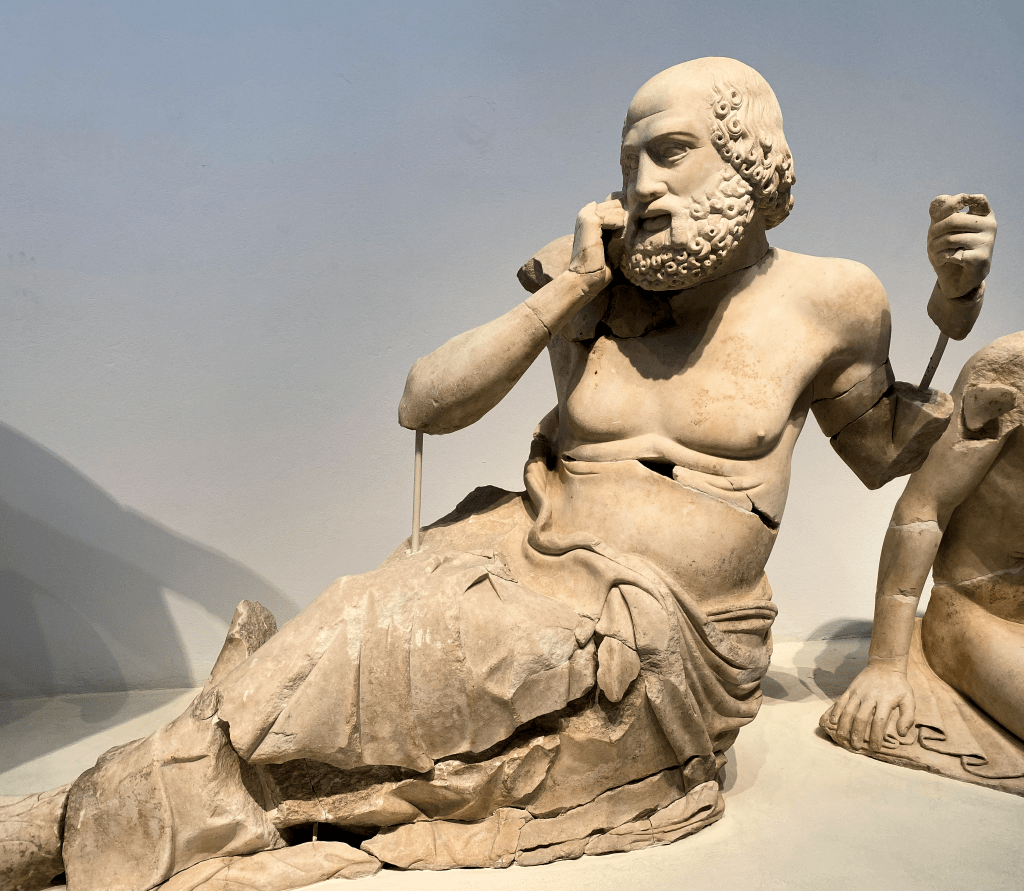
The final stop on the way out of ancient Olympia is the museum that sits just outside the temple grounds. Walking through the halls you begin to gain more appreciation for the advancement of tools excavated from the site. There are advanced metal shaping examples found here as well as an advanced grasp of pottery making and artistic design. There are also a number of marble statues featured throughout the museum still smooth as if modern sandpapers and polishing compounds existed back then. And then suddenly as you turn one final corner on your way out of the exhibit, there is a massive hall of statues , some with broken arms or legs but most intact. Then, one figure with the curly hair and facial features of Zeus caught my eye.
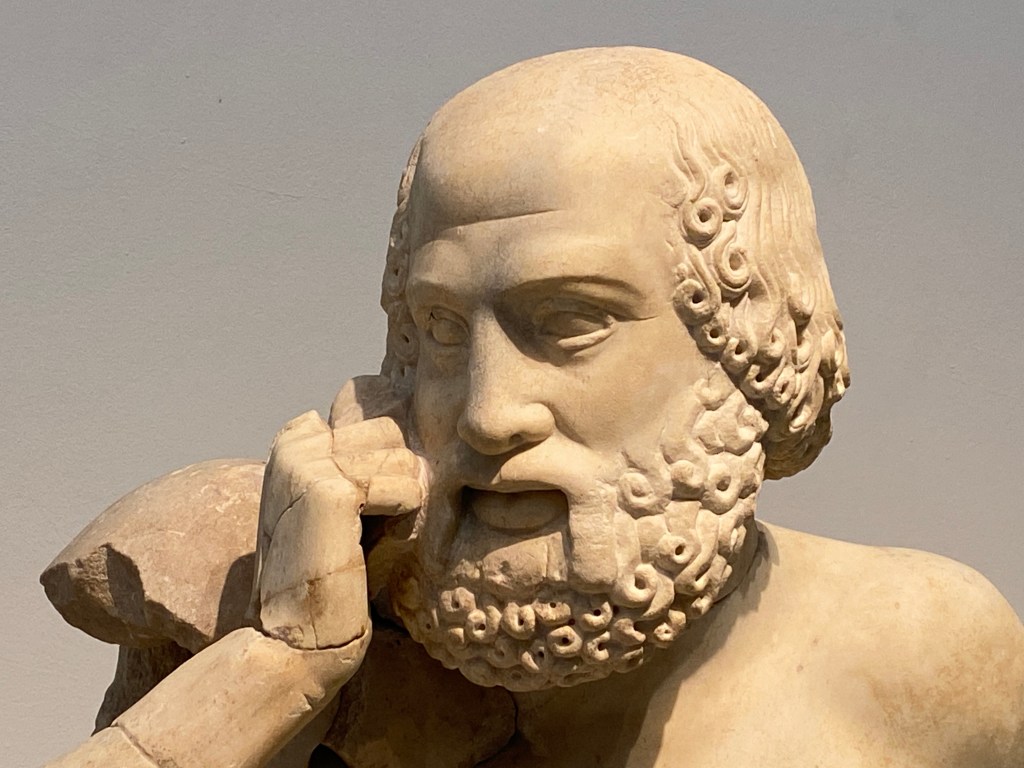
He was laying on the ground, body propped up to the right as he rested an elbow on something (now missing in the sculpture) and his legs were stretched out to the left. He was semi upright as if bringing himself up from a flat laying position so he could concentrate on something that required his attention. His right elbow was bent casually, bringing up his arm towards the side of his head while his right hand was holding something up to his ear. His mouth was closed and his head was cocked slightly as if leaning into and paying attention to whatever he was holding in his hand. He was looking slightly downward and off to the side, the sort of body language you could expect to see when someone is concentrating on what they were hearing or experiencing. What was he holding up to his ear?
The object in his hand was rectangular in shape and comparatively thin; much thinner than a book or any other object you might hold in your hand, against your ear. I mean, why would you be holding up a book to your ear? The outer dimensions of the object in relation to the size of the sculpture’s head and the ability to hold the object in one hand with fingers wrapped around it, suggests that it could have only been one thing. This is clearly the earliest evidence of cellular phone technology in existence. The pictures don’t lie. The statue doesn’t lie.
We can also surmise that these cell phones did not yet posses the ability to take pictures, or we would have seen photos pop up as artifacts in the museum. No, the invention of the mini camera and the digitization of images into pixels was all our doing. We’ve taken that ancient Greek invention one step further so that educated and world traveling people could snap pictures of Greek gods in various stages of undress talking on cell phones. Or, instead of capturing pictures and memories of new places, landscapes and ancient architecture we could just take a million pictures of ourselves filling up the camera frame with a little broken limestone column in the background. And this leads to a cell phone rant.
Taking Selfishes
You could call them “selfies” as is the popular term, or you could call them what they truly are. With my satirical cell phone story out of the way and while wandering the site at Olympia, we encountered a family from an Asian country who seemed to be quite insistent that they should be at the front of the line for every photo opportunity available. If another tourist started to walk innocently within camera frame of whatever they were shooting, the older woman in the group would hold out her arm to keep people back or stop them from ruining whatever shot they were taking. But, they weren’t taking pictures of the ruins or the columns or the temple.
One of the younger twenty somethings in this group was not a family member and I’m guessing it was the young girl who looked like a model, literally on her own personal photo shoot. The motherly figure was dressed on a puffy multi colored jump suit fashioned in some sort of shiny paisley patterned material, constantly pointing her finger around the grounds and barking out directions. There were the older grandparents in the entourage, more modestly dressed and as quiet and motionless as church mice when a cat is near. The twenty something young man was less concerned about dressing fashionably because he was wearing jeans and a bright tee shirt that said “Olympia”; something you could only find at a cheesy souvenir shop in town that same day. He literally had to change into that shirt immediately after buying it. His job, his only job was to take pictures of his girlfriend and only pictures of his girlfriend. There was not a single instance I could find where he captured an image of the site without this girl filling up the frame.
She was wearing a well fitted, slim but not clingy white dress down to the knee. It was of a style that you could imagine Audrey Hepburn wearing while performing in Breakfast at Tiffany’s. She had on a pair of wide rectangular and dark sunglasses which seemed to be similar to expensive Italian frames we saw featured on billboards at the Venice airport. She spoke sharply and condescendingly to the boyfriend, barking out orders for how she wanted each frame shot. She would wave her hand vigorously to get him to move to the right or left. Then she would make sure to pull her hair from the back of her neck and twist it to lay over her shoulder to complete the pose, pretending to hold up a column, or pointing to the stone alter where the Olympic flame gets lit before each new set of games.
This was not a story I went looking for or ever intended to write about. This little family group and vapid ingenue kept buzzing around the ruins, stepping in front of our group wherever we went. Her energy, as was her heightened focus on self interest was endless. There were at least 50 pictures taken as I estimate their escapades that particular day, and all of them were of this girl in various uninteresting poses while the boyfriend scurried around her, fumbling with the cell phone camera in order to keep her happy. I can’t imagine the scene as she shows these pictures to people. That encounter must be something like:
“Here’s me in front of the temple of Zeus. You can’t really see the temple but it’s right behind me. Here’s me in front of a marble column. Here’s me in front of the Olympia alter where they light the Olympic flame. Here’s me holding up a leaning arch. Here’s me pointing to a fallen statue. Here’s me… Here’s me… Here’s me.”
Best of luck with that one, young man.
Maybe the ancient Greeks were smart after all. Perhaps the down side of advanced technology was realized more than 2000 years ago and the Greeks just chose to bury that pesky cell phone technology then and there. Maybe it was for the better. Maybe it was best to hide the fact that cell technology was even available back then and that its use was filled with undesired changes to their lifestyle. That was until we unearthed a statue proving the use of cell phones at ancient Olympia. The secret is out.
Now in retirement I have loosened my attachment to cell phones. I even find that I forget to take it with me if I need to dash off to the hardware store or to get a haircut. I don’t miss the constant mandate from my employer to keep it turned on and handy because “we might need to reach you night and day, on weekends or holidays”, and yes, they have. Is it an act of selfishness NOT to carry one? I find that I’m actually happier by relinquishing that ever present tether to the outside world. It allows me to be MORE present and focused when I’m in the wood shop, or of course, when looking around the fascinating site that it the ancient ruins at Olympia.
“Hey! That carved marble dude is holding a cell phone!”
 TFW Woodworking