I should be happy now that we have our lake restored after years of looking out at invasive weeds, dead grasses and swampy flat lands. The water is back and the view is dramatically improved but a closer look reveals the current health of the lake is visually and demonstrably toxic. Plumes of thick algae, green tinted water and numerous dead, rotting fish now serve as the lake’s new identity.
The Sanford Dam failure of 2020 left miles of home and shoreline destruction. With rebuilding of destroyed homes and water management systems, hope and joy was renewed as the lake returned earlier this year. Three weeks after the water returned, grass like weeds sprang up all around the shallower parts of the lake, rising up three feet or more above the lake bed. Normally safe for powered watercraft, the weedy areas now needed to be avoided. Boaters could navigate around weedy patches and were still happy. Homeowners had a nicer view. Steps were taken to remediate some of the weed growth.
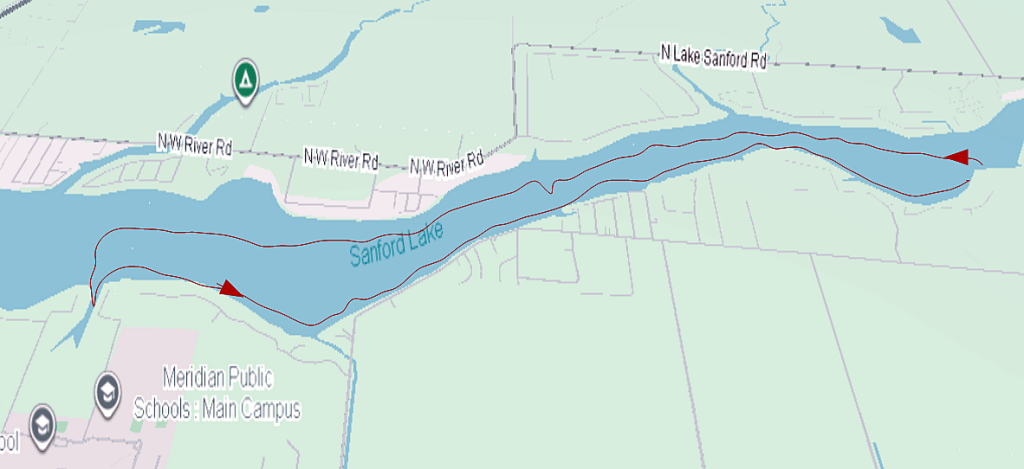
This weekend early in August, I took an extended canoe trip down Sanford Lake starting from about it’s midpoint South towards the high school. My round trip covered about 6 miles and since it was early morning with no boat traffic, I started my journey right in the middle of the lake. It gave me a nice view of the sunrise on my left and the opposite shoreline bathed in a golden glow.
It didn’t take long to spot the first floating object along my path. Normally I’ll pick up boater trash during my trips. You’d be amazed at what gets tossed overboard or accidentally blown overboard. I’ve picked up seat cushions, koozie can coolers, plastic toys, inflatables, empty bottles and boat fenders. But, this rounded white float was the belly of a fish that looked like a juvenile variety of bass about 6 inches long. Maybe it wasn’t bass, though all of the fish were the same species. It was definitely not a catfish or carp variety, but I skipped the pick up and paddled on.
Soon I spotted another dead fish of the same variety, and then another, and yet another again floating in the middle of the lake. I started to count. I only counted those fish that were directly in my canoe line, easily visible and identifiable as a belly up fish, meaning I count not accurately account for all dead fish beyond my sight line. My canoe path is laid out below in the attached graphic. As I paddled on I began to think about what was being sprayed into the water. The local authorities will inform us when they intend to spray for weeds (or anything else for that matter) and the weed control chemicals are not supposed to be toxic for fish. 7, 8, 9.
There are a few spots out in the middle of the water where the lake bed rises up, leaving a shallow area between 4 and 5 feet deep. 4 to 5 feet deep seems safe enough for boating depth, but it still allows some grassy weeds to pop up above the water line. Small clumps of grassy weeds tend to keep boats away, but a canoe glides right through. More dead fish have been trapped here. 17, 18, 19. About a mile into my trip I hit one of the wider and deeper parts of the lake and the fish count dropped off a bit. I wondered if the water clarity or lack of oxygen in the water might be a problem. Heavy algae growth is known to absorb oxygen and can lead to large scale fish kill, but all this freshly fed river water?
One of my favorite wood shop projects, aside from finishing the build of our cedar strip canoe, was the one-day build of my canoe paddle. I especially liked using some bright white Aspen wood for the blade of my paddle, offset by a thin strip of Mahogany down the center line. It’s a pretty paddle to look at and use, and the white tone of the wood also serves as a litmus strip as you dip the paddle in water. I’m not sure why it took this long to pay attention to the color of the water, but the water is noticeably green against the white Aspen wood of the blade. 23, 24, 25.
Three miles into the journey I could hear the whine of SeaDoo engines off in the distance. My uninterrupted peaceful paddle came to an end as I decided to turn around and head back. I stopped at an alcove along the Eastern shore right about where Meridian high school was located. This canal went in far enough to support 4 to 5 homes on either side. The water was shallow and the trees provided good shade on both sides of the inlet, but the water was thick with tall weeds and algae blooms. Dead fish were everywhere. At one point the water took on the consistency of a thick soup, making it difficult to advance the motion of the canoe. I back paddled and pulled myself out to thinner water so I could turn around and get back to the main part of the lake. 39, 40, 41. It seems ridiculous now as I write this to have described my canoe experience, in the Great Lake State no less, as needing to find “thinner” water for canoeing.
As the power boats woke up on this last day of the weekend, they were not to be denied a high octane attack on the water. I doubt any of them, traveling at more than 40 miles per hour, saw the color of the water or the little white bellied fish floating in their way. I stayed well clear of the lake’s center but that also kept me closer to shore and the shallower parts of the lake among the weeds. There are benefits and drawbacks among the weeds. Tall patches of weeds tend to absorb the wake of a passing boat making my life less turbulent. But, shallow water and weeds are the perfect breeding ground for large clumps of algae blooms. More and more dead fish are found among the weeds.
Spotting a floating piece of plastic garbage, I headed over to collect it and found myself gliding to a dead stop as I pulled closer. Somehow I had managed to nestle the bottom of my canoe on top of an algae bloom so dense and wide as to resemble a cumulus rain cloud. It held me in place. I reached out with my paddle to grab the plastic and then tried to paddle forward. Do not pass go. I could not collect my $200.
I checked the water depth with the paddle to make sure I didn’t run aground. I was in 2 feet of water, stuck. I gave a couple of full force strokes on my right side to push myself forward and only gained a few inches. I didn’t panic, but I also knew there was no freaking way I would be getting out of my canoe in this muck to pull myself free. More hard pulling and more cuss words later and I found some thinner water again to get free. The dead fish were all over the place here. 69, 70, 71.
At this point in the story I seem to be beating a dead horse, quite literally, when talking about the conditions of the water and the fish. All along the Eastern shore of Sanford lake in among the weeds and the thick algae were an endless string of these dead floaters. In parts where the fish had been there a while, the smell was quite pungent. Not what you would imagine when planning a peaceful canoe excursion on a calm, windless, sunny Sunday.
It was a nice workout for an old retiree. My shoulders ached a little and the center line of my back was covered in sweat, normal for a longer canoeing effort. It seems like this 6 mile journey is about all I can take now without my hands feeling like they’re about to blister. It started out as a pleasant journey but quickly devolved into an environment observational session coupled with a Kindergarten counting class. As I pulled into my canoe launch back home, I stopped my dead fish count at 107. There was one more floating near my dock just to punctuate the end of that sentence. I can only image what the total count might be across the entire lake.
I’m not a fatalist. I know the lake returning means it needs to find equilibrium again. Invasive non-lake weeds weeds will go way in time. A diverse fish population will take years to achieve. Environmental experts tell us it will take time to restore a normal lake life cycle. I get it, I do. But the current state of affairs on Sanford Lake, up close and personal anyway, is pretty disheartening. Maybe I need to buy a fast boat again and limit my time on the water to speed oriented experiences. Everything looks wonderful on the water as you fly by little hidden details at speed.